Star trails
Around Polaris
A still camera turns Earth’s rotation into a drawing

What is it?
A record of the sky’s apparent motion over time. As Earth rotates, stars trace arcs around the projected rotation axis.
What can you see?
Follow the circles towards their centre. That point is the north celestial pole. Polaris lies nearby, which is why it appears much steadier than stars farther from the pole.
Is Polaris really that close?
At roughly 430 light years, Polaris is comparatively nearby on the scale of our galaxy. The North Star is special because of where it appears in the sky, close to Earth’s extended rotation axis. It does not have to be the brightest or most distant star. The other stars in the trails are spread across many distances.
Are the stars circling Polaris?
No. The circular pattern comes from our turning viewpoint on Earth. The length of a trail depends on elapsed time and distance from the pole. It does not directly measure a star’s speed through space.
This is a different aim from a tracked deep-sky image: here, the movement is the subject.
Behind the photo · optional experiment
Turn Earth and draw the trails
Let a fixed camera watch the sky as Earth turns. Change elapsed time to grow the arcs; the stars are not circling Polaris in space.
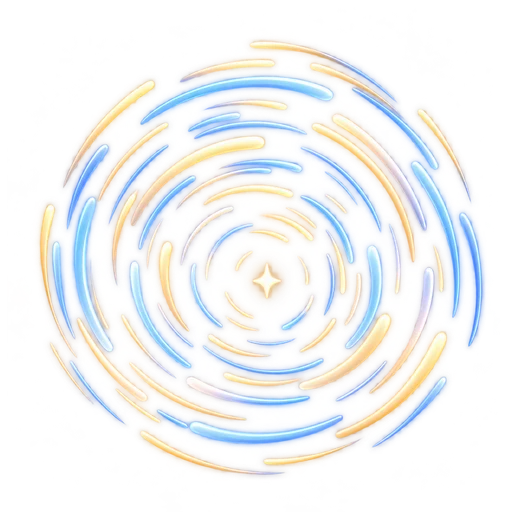 Journey illustration · not a photograph
Draw the star trails
This experiment changes the physics or the viewpoint. Your photograph stays as the reference observation.
Open the full Lab view ↗